Skip to content

The Link Between High Myopia and Serious Eye Diseases

Are You at Risk?

Are You at Risk?

High myopia, often referred to as severe nearsightedness, is a condition characterized by a high degree of myopia, resulting in significant difficulty seeing distant objects. While myopia can pose challenges, individuals with high myopia face an increased risk of developing severe eye diseases that can lead to vision loss. Understanding the connection between high myopia and these eye conditions is crucial for early detection and intervention.
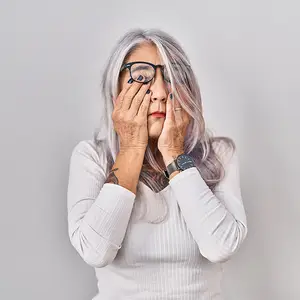

An older woman in a white long sleeve shirt and glasses covering her eyes with her hands
A man working at a desk with a laptop, he is holding his head in his hand with glasses on his lap, he is wearing a green shirt.

Defining High Myopia

High myopia is typically diagnosed when a person's prescription exceeds -6.00 diopters. It often occurs when the eyeball becomes elongated, causing light to focus in front of the retina instead of directly on it. This structural change sets high myopia apart from mild to moderate myopia.

Serious Eye Diseases Associated with High Myopia

  • Retinal Detachment

    High myopia significantly raises the risk of retinal detachment, a condition where the retina, the light-sensitive layer at the back of the eye, detaches from its normal position. This separation can lead to vision loss and requires immediate medical attention.

  • Retinal Tears and Holes

    High myopia can lead to the development of retinal tears or holes, which may be precursors to retinal detachment. These issues must be addressed promptly to prevent further complications.

  • Glaucoma

    Individuals with high myopia may face a higher risk of developing glaucoma, a group of eye diseases that can damage the optic nerve and result in vision loss. Regular eye exams are crucial to monitor and manage this condition effectively.

  • Cataracts

    While not directly caused by high myopia, individuals with high myopia may experience an earlier onset of cataracts, which cloud the eye's natural lens and lead to decreased vision.

  • Myopic Macular Degeneration

    High myopia can contribute to the development of myopic macular degeneration, a condition affecting the central part of the retina (macula). This can lead to central vision loss, impacting one's ability to see fine details clearly.

Strategies to Reduce Your Risk of Serious Eye Conditions

While high myopia is associated with an increased risk of severe eye diseases, there are steps you can take to reduce this risk:

  • Get Regular Eye Exams

    Routine eye exams are essential for early detection and timely intervention. Your eye care professional can monitor the health of your eyes and address any emerging issues promptly.

  • Myopia Management

    If you or your child has high myopia, myopia management strategies, including orthokeratology (ortho-k) and low-dose atropine, can help slow the progression of myopia and reduce the associated risks.

  • A Healthy Lifestyle

    A balanced diet, regular outdoor time, proper exercise, and lifestyle choices that promote overall health can contribute to better eye health. This can reduce your long-term risk of severe eye conditions.

  • Protect Your Eyes

    If you engage in sports or activities that pose a risk to your eyes, consider protective eyewear to prevent injuries that could exacerbate eye issues.

Patient Reviews

4.5
190 Reviews
5
4
3
2
1
Joe P. - May 8, 2026
I have been a patient of this office for a few years now. I wear both glasses and contacts. I feel c... onflicted however because I like smaller/more private eye clinics like this vs. major retailers. That being said, I struggle with the pricing. First, let me say that everyone at the office is extremely nice and friendly. The doctor(s) are extremely nice, helpful, and explain things well. Yesterday I went with the intention of altering the type of contacts I wear as I had been wearing Precision 1 (Dailies) for astigmatism,but they simply cost too much. So I wanted to go back to either 2 week disposable or (preferably) monthly disposable. I brought my 3 pairs of Oakley eyeglasses which are all in good shape, I asked to be fitted for monthly contacts as they are one of the cheapest and was told that 2 week disposables would be the best for my situation. I had no problem with the suggestion and we went with Acuvue Oasysis w/hydroglyde. The Dr. also checked my most current pair of Oakley glasses and made an adjustment to the lenses, which, while in the chair, definitely seemed to make a difference. Now comes the confusing part. I hate vision benefits as they don't seem to cover enough for what the price of quality eye products cost---but that certainly isn't the office'e fault. My benefits allow EITHER frames and contacts or lenses and frames per year. But, I wanted to see how much it would be to put the updated prescription of lenses into my most current Oakley frames and use my benefits towards the disposable contacts. My allowance is $130 for disposable contacts. Single vision lenses are paid in full and based on the additives selected (scratch-resistance, polycarbonate, etc, have copays). I was told I would get the best use of my insurance on the lenses and pay out of pocket for my contacts. I was prepared to hear a total between $400-$500 for everything since I was buying 6 months of contacts and was told my Oakleys needed a "thinner" type of lense. The contacts, and whatever I had to pay for the contact lense fitting and evaluation, plus that eye-scanning test that's around $44, was $383.47. Then I heard the total to put the new lenses in my glasses and it would have been somewhere around $240!! I was not prepared to pay roughly $624 so I asked that we simply hold off on the lenses, and use the benefits for my contacts. So I paid $383.47 for contacts with plans to come back in a few weeks to have my lenses put into my glasses. My girlfriend was with me and we were talking and the amount I paid just seemed high. Plus, I didn't receive any type of itemized statement for the services provided, their cost, and what the insurance was to pay. I decided to go to Visionworks in South Hills Village Mall on the way home. I walked into Visionworks, pulled up my current prescription, and told them I simply wanted to see what the cost would be to have the lenses put into the frames. The lady called EyeMed and was told I would be responsible for a $40 copay for polycarbonate, that's it!!! (I didn't think I could get lenses since I just got contacts) but I wasn't going to argue. So, rather than $240 (roughly) for 1 pair of lenses that I was quoted, Visionworks charged me $40 for new lenses put into the same frames. AND, since they were having a buy 1, get 1 50% off, she took my back-up Oakley glasses and I'm getting the new prescription lenses put into THOSE frames also. I walked out of VisionWorks paying $155 for 2 sets of new lenses with polycarbonate and scratch coating rather than paying $240 for 1 set of lenses!!! This makes me wonder if I was way overcharged for my contacts? Today, I asked to have an itemized statement sent to me from Your family Eye Doctors to see the cost per box and with the insurance paying for $130 worth. Again, I have no problem with Your Family Eye Doctors. They are professional, clean, thorough, and have a large selection. My only feeling is that it's a bit pricey as I would have paid about $624 and paid $538 between the two providers (and I'm receiving an extra pair of lenses).
Nonno 3. - Mar 28, 2026
I went to Family Eye Doctors to see if they could repair my badly mangled glasses. I was very pessi... mistic. Showed up without an appointment, but they fixed the glasses in minutes, even though I was never a patient at this practice before. No charge! And the staff is so friendly. I will be using Family Eye Doctors for all my vision needs from now on.

Myopia Management in Murrysville

Exterior view of our Family Eye Doctors - Murrysville optometry practice.
Photograph of Chris Cakanac
Hours
  • Monday 8:00 am - 6:00 pm
  • Tuesday 9:00 am - 7:00 pm
  • Wednesday 8:00 am - 6:00 pm
  • Thursday 8:00 am - 6:00 pm
  • Friday 8:00 am - 4:30 pm
  • Saturday 8:00 am - 12:30 pm
  • Sunday Closed
Insurance Plans
  • Medicare
  • United Healthcare
  • Spectera
  • Medicaid
  • Anthem
  • Anthem Blue Cross Blue Shield
  • Blue Cross
  • MetLife
  • Aetna
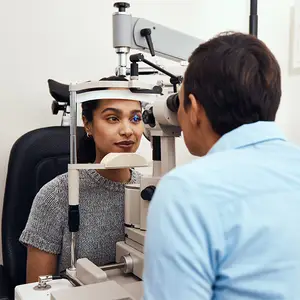
A woman is sitting in a chair and having her eyes examined by a man wearing a blue shirt.

Your Family Eye Doctors - Murrysville: Your First Line of Defence Against High Myopia

The link between high myopia and serious eye diseases underscores the importance of proactive eye care. If you have high myopia or a family history of the condition, regular eye exams and discussions with your eye care professional are vital to safeguard your vision and reduce the associated risks.

Contact Your Family Eye Doctors - Murrysville to schedule an eye exam, and let us guide you through high myopia and its potential impact on your eye health.